Lital Szmuk Fabian
Noa Marom
Ziv Leibo
Mann-Shinar Architects
Moshe Tzur Architects
Hufton+Crow
Ramon Airport, named after Ilan and Assaf Ramon, was established in the Arava Desert, between Timna and Eilat, east of Route 90 and only several dozen meters from the Jordanian border, adjacent to the Evrona Nature Reserve, on the alluvial fan of the Numeira Stream. Unlike other civilian airports in Israel, which were built on former military airfield infrastructures, Ramon Airport is the first airport in the country designed from the outset as a civilian airport. It was planned by Mann-Shinar Architects and Moshe Tzur Architects, a fact that enabled the creation of a comprehensive architectural and landscape language for the entire airport.

Lital Szmuk Fabian
Noa Marom
Ziv Leibo
Mann-Shinar Architects
Moshe Tzur Architects
Hufton+Crow


The southern Arava landscape in which the airport is situated is dominated by alluvial materials: alluvial fans, sand formations, salt flats, and braided drainage patterns. The alluvial fan on which the airport was built is a fan-shaped accumulation of sediments formed when the fast flow of a stream slows down.
These areas are characterized by vegetation that traces the delicate channels of the fan’s drainage system. Salt flats, by contrast, result from local depressions with no outlet, into which some of the streams flow, creating a distinctive landscape of cracked and peeling ground surfaces.


Opposing the desire to preserve the values of the local landscape was the aspiration to create an oasis - a green, welcoming mantle for those arriving in the desert. The tension between these two impulses shaped our design.
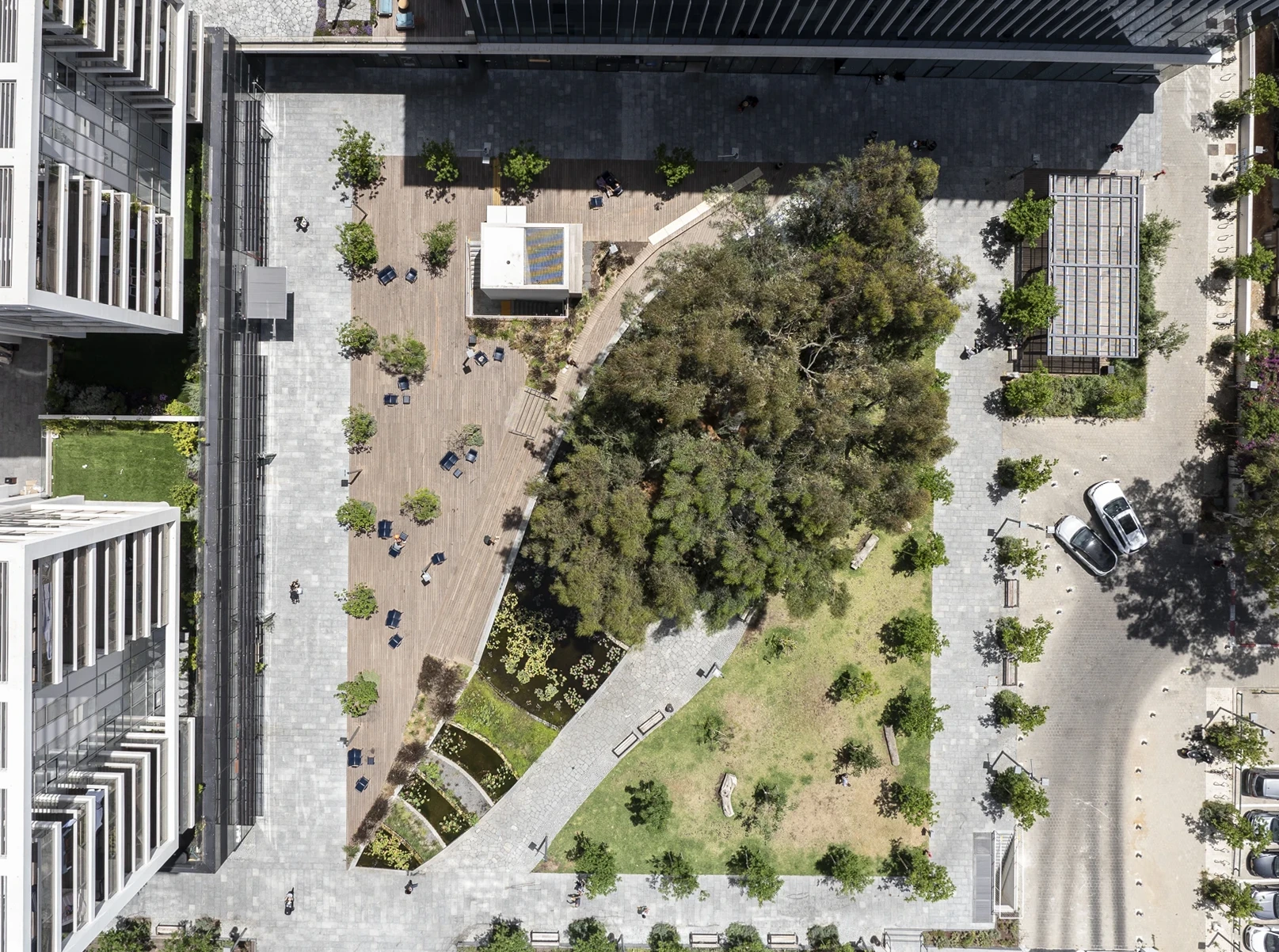
In the parking areas, planned in a delta configuration, a clear separation was created between pedestrians and vehicles. The pedestrian paths leading passengers toward the terminal are paved with natural stone, and elongated planting beds with concave cross-sections reminiscent of ephemeral desert streams - are integrated within them. The central path through the parking areas leads to the future railway station. Above the paths, and following the same geometry, longitudinal pergolas were designed to provide shade for pedestrians on their way to and from the terminal.


Inspired by the cracked ground patterns of the salt flats, the landscape surrounding the terminal building was designed accordingly. In contrast to the dynamic, movement-oriented delta configuration, the ground cracks represent stillness and pause appropriate for waiting in the terminal, the passengers’ primary space of dwell time. The main waiting hall allows uninterrupted views toward the Edom Mountains. Passenger movement within the building continues the delta logic of the parking areas, flowing toward the mountains.
The building is composed of two volumetric masses connected by bridges, with an elongated patio between them. Although primarily an operational space, the patio is visible to passengers crossing the bridges. Within it, we designed large concrete castings in hues of the local sand, mimicking ground fissures and altering their scale in relation to the passengers’ elevated viewpoint. Between the fissures, geophytes and seasonal flowering plants were planted.

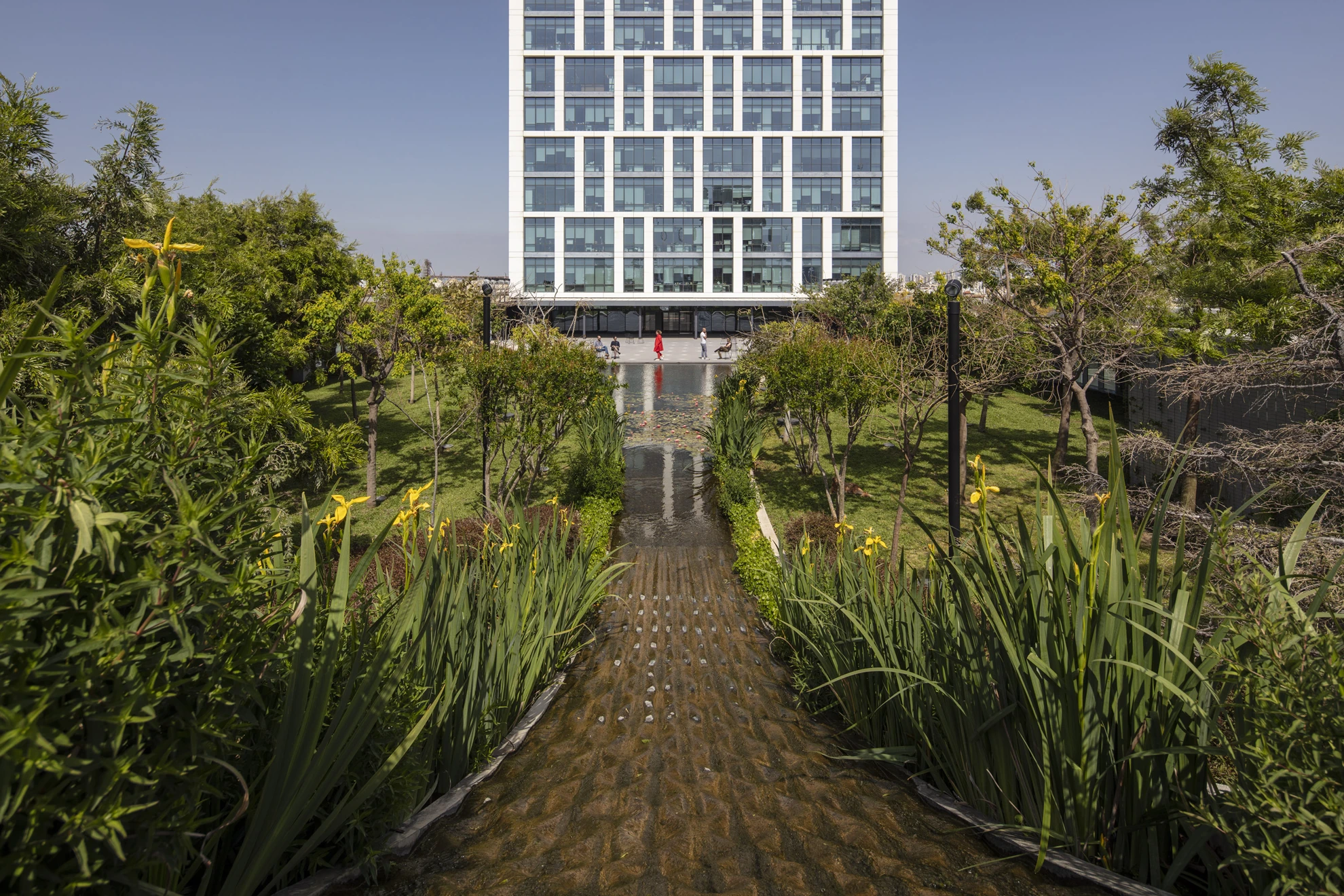
At the heart of the building, an additional patio was designed to bring natural light into the interior, physically separating yet visually connecting arriving and departing passengers. Using the same formal language of ground cracks, we designed a space that gradually becomes richer in vegetation and water. At the innermost part of the patio, a biological pool with lush planting was created, inspired by the springs of the Arava, featuring species such as Euphrates poplar and common reed, alongside bamboos and water lilies.
From the air, the airport appears like a frayed blanket laid over the existing landscape, with the terminal at its center resembling a massive white rock, its edges merging directly with the ground. The delta form gleams in the sun and is visible from afar, while Numeira Stream has already carved new flow paths during the last winter toward the Evrona Nature Reserve. The airport has now become part of the landscape - not only for humans, but also for the plants and animals that inhabit the desert



%20NoWaterMark.jpg)